Magnetic Van Signs: A UK Guide to Sizes, Fitting, Rules and Prices
October 22, 2026
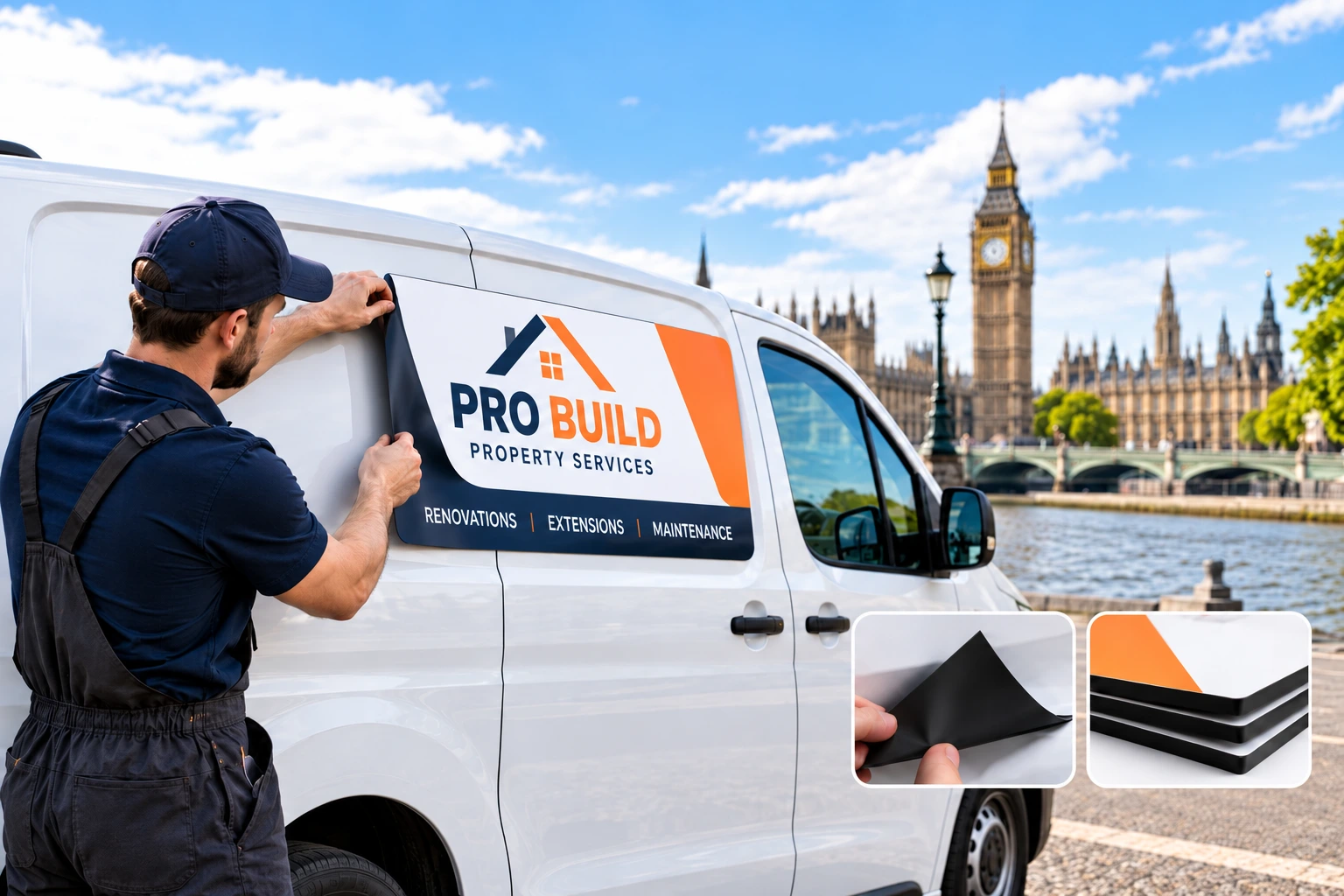
Magnetic van signs are printed, flexible magnetic panels that grip the steel body of a van, giving you removable van advertising without permanent vinyl. They suit tradespeople and anyone who uses one vehicle for both work and personal journeys, provided the panel is flat, ferrous steel and the sign is removed and cleaned regularly.
This guide covers what the signs are made of, whether they work, which vans and panels they fit, sizes, design, the legal questions people ask most, fitting and care, and what you should expect to pay in the UK.
Magnetic Van Signs Overview
| Magnetic van signs at a glance |
What you need to know |
| What they are |
Printed flexible magnetic sheet that holds onto steel body panels |
| Typical material thickness |
0.85mm is the most common listing among the UK suppliers we checked |
| Common sizes |
300 x 150mm up to 1500 x 600mm, with some listings reaching 2500 x 600mm |
| Works on |
Flat, clean, dry ferrous steel panels |
| Does not work on |
Aluminium, plastic, fibreglass, carbon fibre or composite panels |
| Care routine |
Remove and clean underneath at least weekly (more often in wet weather) |
| Typical lifespan |
Around two years with proper care, based on supplier guidance |
| Price examples (October 2026) |
From about £17 for a small pair to around £230 for a vehicle-specific cut-to-shape set |
What Are Magnetic Van Signs?
A magnetic sign is a sheet of flexible magnet with your printed design laminated or printed onto the non-magnetic face. You press it onto a steel panel, it holds by magnetic force rather than adhesive, and you peel it off when you no longer need it. Unlike rigid acrylic signs made for a wall or counter, vehicle advertising magnets bend to follow gentle curves in bodywork and roll up for storage.
The same product appears under several names. Magnetic vehicle signs, magnetic car signs and car door magnets all describe the same thing; the difference is mainly which vehicle and panel the sign is sized for. Removable magnetic van signs are usually larger and sold in pairs for the left and right sides.
What magnetic van sign material is made of
Most vehicle-grade sheeting is strontium ferrite powder held in a flexible thermoplastic or synthetic rubber binder, magnetised in narrow alternating poles on one face only. One UK sheeting manufacturer's technical data lists the ferrite content at 85% to 91% by weight. A magnet manufacturer's product data notes that the binder starts to soften above 80°C, which can permanently weaken the magnet. That is one reason suppliers advise against fitting signs to bonnets or leaving them in strong sun for long periods.
Thickness matters. Thin fridge-magnet stock (often around 0.5mm) is not designed for road speeds. Vehicle-grade magnetic van sign material is usually listed at 0.85mm, and some listings quote 0.9mm.
Magnetic car stickers and magnetic posters for cars
Buyers also search for magnetic car stickers and magnetic posters for cars. Both terms usually mean the same printed magnetic panel rather than an adhesive sticker. The magnet is the key feature: there is no glue, so nothing is left on the paint when the sign comes off. Magnetic posters for cars tend to be used for short promotions, events or a one-off launch, while signs for working vans are designed for daily use.
Do Magnetic Van Signs Work?
Yes, for the right business. A van spends hours on local roads and parked outside customers' homes, so it is seen repeatedly by people in your service area. The Society of Motor Manufacturers and Traders recorded 158,648 new light commercial vehicles registered in the first half of 2026, and most of them will carry some form of branding sooner or later. Magnetic signs give you that visibility for a fraction of the cost of a wrap.
The return depends on simple arithmetic. As an illustration, if a pair of signs costs £100 and your average job is worth £150, a single enquiry from someone who saw your van covers the cost. Everything after that is low-cost advertising.
Where magnetic signs do less well is with businesses that want their whole fleet branded permanently, or vans with very few flat steel panels. In those cases van signwriting or a wrap usually makes more sense, which the next section compares.
Who Uses Vehicle Advertising Magnets (and When Vinyl Is Better)
Magnetic signs work best when flexibility is worth more than permanence. Typical users include:
- Plumbers, electricians, builders, landscapers, cleaners and oven cleaners who use a personal vehicle for work
- Subcontractors who sometimes work under another firm's name and need to hide their own branding
- Dog walkers, mobile groomers and mobile hairdressers who want a discreet vehicle outside working hours
- Delivery businesses and seasonal traders running short-term campaigns
- Drivers of leased or hire vehicles where permanent graphics are not allowed
- Gas engineers and other registered trades adding accreditation logos (see the Gas Safe section below)
There is also a security angle. Advertising your trade tells passers-by there may be tools inside. With magnets, you can take the signs off overnight and keep the van anonymous.
If your vans are part of a wider brand, the logo, colours and typeface on the van should match your website, uniforms and printed branded packaging. Consistency helps customers recognise you wherever they see you.
Magnetic signs vs van signwriting vs wraps
| Option |
Typical cost (Transit-size van) |
Fitting |
Removable |
Best for |
| Magnetic signs (pair) |
£80 to £200 |
Fit yourself in seconds |
Yes, as often as you like |
Dual-use vehicles, subcontractors, testing a design |
| Cut vinyl van signwriting |
£150 to £400 |
Professional fitting recommended |
Semi-permanent |
Simple, permanent lettering |
| Half wrap |
£700 to £1,800 |
Professional, usually a day |
No |
Strong branding on a budget |
| Full wrap |
£1,500 to £3,500 |
Professional, one or more days |
No |
Fleets and maximum visual impact |
Cost ranges are from a 2026 UK trade vehicle graphics guide. Prices vary by region, van size and design.
Will Magnetic Signs Fit Your Van?
Magnetic signs only hold to ferrous metal. If the panel is aluminium, plastic, fibreglass, carbon fibre or a composite, the sign will not stick at all, however strong the magnet.
The fridge-magnet test
Before ordering, hold an ordinary household magnet against the exact area where the sign will go. If it does not grip firmly, a magnetic sign will not work there. Test several points on each panel, because some vans mix steel and non-steel parts, and repairs with body filler can weaken the hold in one spot.
Panels and features to avoid
The whole sign must sit flat with full contact. Air under any edge reduces grip and lets wind get underneath. Keep the sign clear of:
- Door gaps and panel joins (a sign must never bridge two panels)
- Swage lines, creases and deep grooves pressed into the bodywork
- Door handles, plastic trims, rubbing strips and badges
- Deadlocks and rear cameras, which vary in position between vehicles
- The bonnet, where engine heat and airflow are both a problem
- Damaged, peeling or freshly painted areas
Magnetic van signs by model
Popular UK vans fall into three size groups, and each group has a typical fitting focus. Small vans have shorter panels, so door-sized signs often fit best. Medium vans usually have a sliding side door, so check that the sign will not cross the door track. Large vans have tall sides but often more pressed features, so measure the flattest area between them. The Ford Transit Custom was the UK's best-selling van in June 2026 with 3,430 registrations, ahead of the Peugeot Partner, according to SMMT data.
| Common search |
Van |
Size group |
What to check first |
| magnetic van signs ford transit |
Ford Transit |
Large |
Flat area between pressed lines on the load area sides |
| magnetic van signs transit custom |
Ford Transit Custom |
Medium |
Sliding door track and rear door windows |
| magnetic van signs ford transit connect |
Ford Transit Connect |
Small |
Front door panel size and handle position |
| magnetic van signs vauxhall vivaro |
Vauxhall Vivaro |
Medium |
Sliding door track; panel height above the rubbing strip |
| magnetic van signs vauxhall combo |
Vauxhall Combo |
Small |
Short side panels; consider door signs |
| magnetic van signs citroen berlingo |
Citroën Berlingo |
Small |
Front door and rear door sizes |
| magnetic van signs citroen dispatch |
Citroën Dispatch |
Medium |
Sliding door track and wheelbase length |
| magnetic van signs for renault trafic |
Renault Trafic |
Medium |
Wheelbase and side door configuration |
| magnetic van signs renault kangoo |
Renault Kangoo |
Small |
Side panel length and door handles |
| magnetic van signs peugeot expert |
Peugeot Expert |
Medium |
Sliding door track and rear door glazing |
| magnetic van signs peugeot partner |
Peugeot Partner |
Small |
Front door panel and handle position |
| magnetic van signs peugeot boxer |
Peugeot Boxer |
Large |
Roof height and the flattest area on each side |
| magnetic van signs vw transporter |
Volkswagen Transporter |
Medium |
Pressed lines along the side and the door track |
| magnetic signs for sprinter van |
Mercedes-Benz Sprinter |
Large |
Tall sides with pressed features; measure carefully |
Model searches such as “magnetic van signs - VW Caddy” follow the same rule as any small van: measure the front door and side panel, test with a magnet, and order a size that sits inside the flat area with a margin on every side.

Vehicle Magnetic Signs Sizes and Shapes
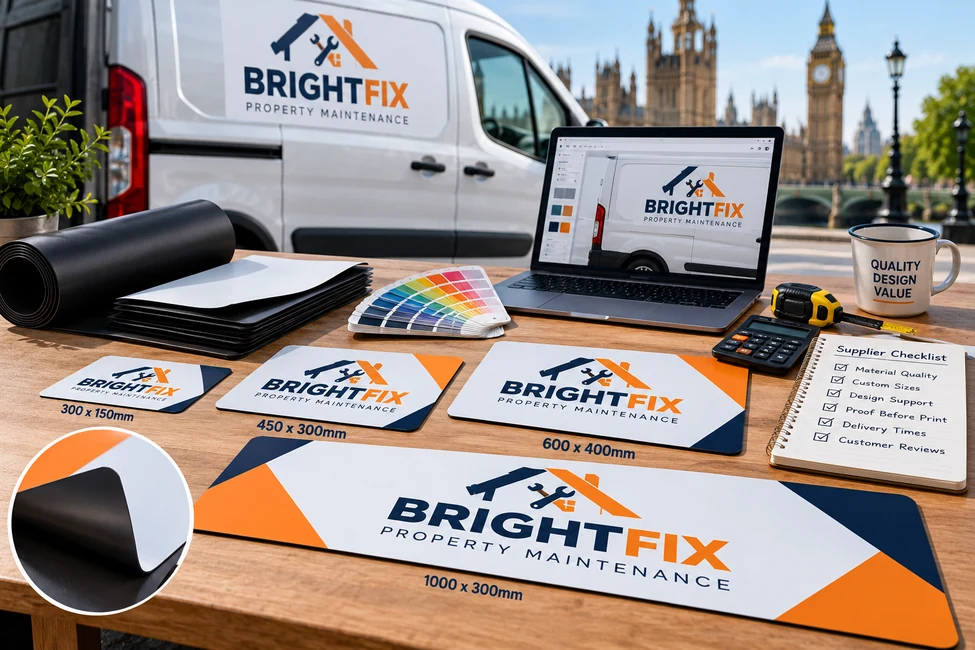
Measure the flat area first, then choose the sign. A sign should sit comfortably inside that space without touching any edge, crease or handle. The sizes below are common starting points, not fixed rules for any particular van.
| Size (mm) |
Common starting point for |
| 300 x 150 to 300 x 300 |
Small car doors, rear doors on small vans, logo-only signs |
| 450 x 300 to 600 x 300 |
Front doors on cars and small vans; a popular all-round size |
| 600 x 400 to 600 x 600 |
Rear doors and side panels on medium vans |
| 800 x 400 to 1000 x 600 |
Side panels on medium and large vans |
| 1500 x 600 and above |
Long, completely flat sides on large vans only |
Large magnetic van signs
Large magnetic van signs carry more information and can be read from further away, but they are harder to fit perfectly flat and catch more wind. Only order a big sign if a single steel panel has a completely flat area larger than the sign. Two well-placed medium signs often look better than one oversized sign that crosses a pressed line.
Made to measure magnetic van signs
Many suppliers accept custom dimensions, typically from about 300mm to 1500mm wide. Made to measure magnetic van signs are worth the small extra cost when a standard size would either waste space or overlap a feature. Measure twice, and send the supplier a photo of the panel if you are unsure.
Magnetic van signs cut to shape
Magnetic van signs cut to shape follow the outline of a specific panel on a specific make, model, year and wheelbase, so they cover more of the van and look closer to permanent livery. When people search for the best magnetic van signs cut to shape, the things that separate good sets from poor ones are accurate templates for your exact vehicle version, cut-outs or trim guides for deadlocks and rear cameras, and a design proof shown on an image of your actual van.
Magnetic van door signs, circles and magnet logos
Magnetic van door signs are the most common choice for cabs, because the front doors are usually flat steel and at eye level for pedestrians. Rectangles with rounded corners hold most text. Circular signs, or a magnet logo cut to the outline of your logo, suit businesses with a strong mark and a short message.
Designing Custom Magnetic Van Signs
A van is usually seen for a few seconds, often while moving. Many of the same packaging design mistakes apply here: too much text, low contrast and logos that only work at large sizes. Plan the design for a quick glance.
What to put on the sign
Keep the logo and business details to what someone needs to remember you. A strong layout usually includes:
- Business name and logo
- What you do, in three to five words
- One phone number, large enough to read from a distance
- Website address or a short domain
- Accreditation logos you are entitled to use
QR codes are popular, but they only work when the van is parked and someone is close by. Treat them as an extra, not the main call to action.
Letter height and readability
Traffic sign research gives a useful rule of thumb. Human factors guidance published by the US National Academies recommends a legibility index of no more than 40 feet per inch of letter height, and road sign practice commonly uses about 30 feet per inch. In metric terms, each 25mm of letter height is readable from roughly 9 metres in good conditions.
| Capital letter height |
Approximate reading distance (30 ft per inch) |
| 25mm |
About 9 metres |
| 50mm |
About 18 metres |
| 75mm |
About 27 metres |
| 100mm |
About 36 metres |
Use a plain, bold typeface, strong contrast between text and background, and leave space around each line. Your phone number should be the largest text after the business name.
Van sign ideas that read well
- Lead with the service, not a slogan: “Boiler Repairs and Servicing” beats a clever tagline
- Use one bold brand colour on a light background, or white text on a dark background
- Put the phone number on the rear doors too, where drivers behind you have time to read it
- Match your uniforms, invoices and website so the van feels like part of the same business
- Use a circular logo sign on the front doors and a larger rectangle on the rear
Black magnetic van signs and colour choices
Black magnetic van signs with white or yellow text stand out well on white vans, which are common in the UK. Dark surfaces absorb more sunlight, though, and the magnetic binder softens at high temperatures, so remove any sign during very hot, sunny spells. Avoid matching the sign colour to the van colour, because the edges disappear and the sign reads as a smaller panel.
Magnetic van signs design online
Most suppliers offer magnetic van signs design online, either with a browser-based editor or by uploading your own file. Several free design tools let you create artwork at the finished size, so magnetic van signs design online free is realistic if you already have a logo. Typical supplier artwork requirements are:
- A print-ready CMYK PDF with fonts embedded or outlined
- 2mm bleed on every side (so a 600 x 300mm sign needs 604 x 304mm artwork)
- Text and logos kept at least 10mm inside the finished edge
- Photos at around 300ppi at the final printed size
If design is not your strength, a professional design service is usually inexpensive compared with the cost of a poor sign that runs for two years.
Are Magnetic Signs Illegal?
No. Magnetic signs are legal on UK vans and cars in normal use. The rules that matter are about where the sign goes, how the vehicle is used and what the sign says.
Advertising rules for vehicles
In England, Schedule 1 of the Town and Country Planning (Control of Advertisements) (England) Regulations 2007 exempts advertisements on a vehicle normally used as a moving vehicle, as long as the vehicle is not used principally for displaying adverts. A 2010 High Court case confirmed that parked vehicles used mainly as roadside billboards can lose that exemption. A working van that parks between jobs is fine. A van left in a lay-by for weeks with a large sign facing the road is not. Scotland, Wales and Northern Ireland have their own advertisement control rules, so check locally if your vehicle will spend long periods parked as an advert.
Number plates, lights and windows
Never place a sign over a number plate, light or reflector, or where it blocks your view. GOV.UK states that you could be fined up to £1,000 and fail your MOT for incorrectly displayed number plates. Rear door signs on vans are the usual risk area, so check from behind the van after fitting.
Taxi and private hire vehicles
Licensed taxis and private hire vehicles are controlled by local licensing conditions, and many councils restrict or ban magnetic signs. For example, Southend, Chelmsford and Middlesbrough councils do not allow magnetic attachments for required private hire door signs, and advertising usually needs council approval first. In Northern Ireland, taxi plates and signs are issued and controlled under the Taxis Act (Northern Ireland) 2008. Always check your own licensing authority's conditions before fitting anything.
Gas Safe magnetic van signs
Gas engineers often add the yellow Gas Safe Register logo to their vans. The Health and Safety Executive explains that a gas business must be on the Gas Safe Register to legally carry out gas work covered by the Gas Safety (Installation and Use) Regulations 1998. Displaying the logo without being registered can lead to prosecution. In one recent HSE case, inspector Darian Dundas described an unregistered fitter “faking the Gas Safe logo to tout for business”. If you order gas safe magnetic van signs, use the official logo files and follow Gas Safe Register's brand guidelines, and show your registration number where possible.
Magnetic vehicle warning signs
Magnetic vehicle warning signs, such as learner plates, are widely used because they come off easily. GOV.UK guidance says L plates must be a red letter on a white background at the prescribed size, visible from the front and rear, and removed or covered when a learner is not driving (unless it is a driving school car). Magnetic plates make that easy, but the same flat-steel rule applies.
Insurance and magnetic signs
Tell your insurer. One major UK van insurer's guidance states that it treats signwriting, including magnetic panels, as a modification that must be declared. The Financial Ombudsman Service also notes that undeclared modifications can lead an insurer to refuse a claim if the policy wording is clear. Signs also show that the vehicle is used for business, so make sure your class of use matches how you actually use it.

Fitting, Care and Storage
How to fit magnetic signs
- Test the panel with a household magnet and measure the flat area.
- Wash the panel and the back of the sign with mild soapy water, removing grit and metal particles.
- Dry both surfaces completely. Never fit to a wet, frosty, frozen or hot panel.
- Place one edge of the sign on the panel and let the rest roll down onto the surface.
- Run your hand over the sign and check that every edge and corner sits flat with no air gaps.
- Check the edges again before each journey.
Do magnetic van signs fall off?
A properly fitted, vehicle-grade sign on a flat steel panel should stay put at legal speeds. Most failures come from fitting over a crease or gap, dirt under the magnet, a lifted or damaged edge, thin non-vehicle-grade material, or very strong head winds. Speed claims vary: the suppliers we checked quote ratings between 70mph and 85mph, while one UK sheeting manufacturer says its premium grade is tested beyond 100mph. There is no single industry test, so treat any rating as a guide.
| Vehicle type |
Single carriageway |
Dual carriageway |
Motorway |
| Cars and car-derived vans (up to 2 tonnes laden) |
60mph |
70mph |
70mph |
| Goods vehicles up to 7.5 tonnes (most vans) |
50mph |
60mph |
70mph |
National speed limits from the Scottish Government's road safety framework, which match the GB-wide limits for these vehicle types.
Protecting your paintwork
Magnets do not damage paint on their own. Trapped moisture, grit and uneven weathering do. Remove the signs at least once a week, clean and dry both surfaces, and refit. One UK sheeting manufacturer recommends removal every two to three days, and daily removal after rain is a good habit. Take the signs off before car washes or pressure washing, and ask your bodyshop how long new paint, lacquer or a repair needs to cure before any magnet goes on it. Over months, covered paint can also weather differently from exposed paint, so moving or removing the signs regularly helps.
Storage and magnetic van sign covers
Store signs flat, or loosely rolled with the printed side out, away from heat and direct sunlight. Keep them clean and away from metal dust and debris, which the magnet will pick up and press into your paint next time. Do not fold or put heavy objects on them. If you already have permanent signwriting and need to hide it, plain or printed panels can act as magnetic van sign covers, as long as the area underneath is flat steel.
How long do magnetic van signs last?
Suppliers typically quote around two years with proper care, after which they recommend replacing the sign so it does not lose grip on the road. Lifespan falls with heat, UV exposure, damaged edges and poor storage. A laminated face (matt or gloss) helps protect the print from scuffs and fading, but it does not protect the paint underneath.
Magnetic Van Signs Price and Choosing a Supplier
What magnetic van signs cost
The magnetic van signs price depends on size, quantity, finish and whether design is included. These are examples from UK online listings we checked in October 2026:
| Product type |
Example listed price |
| Pair of small stock-size signs (online marketplace) |
About £17 for two |
| Single laminated sign, 300 x 150mm |
£20 ex VAT (£24 inc VAT) |
| Single laminated sign, 1500 x 600mm |
£56 ex VAT |
| Typical pair for a Transit-size van (2026 trade guide) |
£80 to £200 |
| Vehicle-specific cut-to-shape set with design |
From £230 inc VAT |
Several suppliers offer multi-buy discounts of 10% to 30% when you order more signs, which helps if you are branding more than one vehicle.
Cheap magnetic van signs: what you give up
Cheap magnetic van signs can be fine for a short campaign, but check what is missing. Common trade-offs are thinner material, no protective laminate, square corners that lift more easily, no artwork check and no proof before printing. If the van will do regular motorway miles, pay for vehicle-grade material and rounded corners.
Magnetic van signs next day delivery
Custom work normally needs a design proof and your approval before printing, so true next day arrival is rare unless you supply finished artwork early in the day. The suppliers we checked quoted dispatch around two working days after artwork approval, with transit time on top. When a listing promises magnetic van signs next day delivery, check whether it means dispatch or arrival, and whether the clock starts at order or at proof approval.
Blank magnetic van signs, DIY kits and the Cosco magnetic vehicle sign kit
Blank magnetic van signs are plain magnetic sheets you letter yourself with vinyl letters or cut to shape with scissors. A magnetic vehicle sign kit bundles the sheets with letters. Shoppers searching for a cosco magnetic vehicle sign kit will find two 12 x 18 inch (roughly 305 x 457mm) signs supplied with red and black vinyl letters. DIY magnetic van signs keep costs down, but kit letters are small for road use (see the letter height table above), so they suit temporary messages better than long-term business branding.
Van magnetic holder and roof signs
Some products use a van magnetic holder rather than a flat sheet. Roof signs, for example, often sit on rubber-covered magnetic feet. Check the rubber covers regularly and replace them if damaged, make sure the roof is clean and dry, and remove roof signs in strong winds or heavy rain.
Choosing the best magnetic van signs
The best magnetic van signs are the ones that fit your panels, stay flat and read clearly. Before you order, check that the supplier offers:
- Vehicle-grade magnetic material, ideally 0.85mm or thicker
- Rounded corners and a protective matt or gloss laminate
- Standard and custom sizes, or cut-to-shape templates for your exact model
- A proof before printing, with revisions included
- Clear fitting and care instructions
- Realistic delivery times stated from proof approval
Buying locally or online
Online suppliers deliver across the UK, so the buying checks are the same wherever you are. The local differences are mainly about licensing if you drive a taxi or private hire vehicle.
| If you are searching for |
Nation |
Local rule to check |
| magnetic van signs glasgow, magnetic van signs edinburgh |
Scotland |
Council taxi and private hire conditions; Scottish advertisement rules for parked adverts |
| magnetic van signs swansea |
Wales |
Council taxi and private hire conditions |
| magnetic van signs belfast |
Northern Ireland |
Taxi signs controlled under the Taxis Act (Northern Ireland) 2008 |
| magnetic van signs manchester, magnetic van signs leeds, magnetic van signs liverpool, magnetic van signs sheffield, magnetic van signs bristol, magnetic van signs nottingham |
England |
Council private hire conditions; 2007 England advertisement regulations |
| magnetic van signs hull, magnetic van signs york, magnetic van signs norwich, magnetic van signs plymouth |
England |
Council private hire conditions; 2007 England advertisement regulations |
Your van is often the first piece of branding a customer sees, so it pays to keep it consistent with everything else you print. If you also need branded packaging, labels or signage to match your vehicle livery, you can request a quote from Custom Packaging Pro.
Frequently Asked Questions
- Are magnetic signs illegal on vans in the UK?
No. Magnetic signs are legal on vans and cars in normal use. They must not cover number plates, lights or windows, and licensed taxis and private hire vehicles must follow their council's (or in Northern Ireland, the DVA's) signage conditions, which often ban magnetic door signs.
- Do magnetic van signs fall off at motorway speeds?
A vehicle-grade sign fitted to a clean, dry, flat steel panel should stay on at legal speeds. Signs usually come off because they were fitted over a crease or gap, had dirt or moisture underneath, had a lifted edge, or were made from thin, non-vehicle-grade material.
- How long do magnetic van signs last?
Around two years with proper care is the typical supplier guidance. Heat, strong sunlight, damaged edges and poor storage shorten that, and you should replace any sign that has curled or lost grip.
- Can magnetic signs damage van paint?
They can if dirt or moisture is trapped underneath, or if the paint is new or damaged. Remove the signs at least weekly, clean and dry both surfaces, take them off before washing the van, and keep them off freshly painted or repaired panels.
- Do I need to tell my insurer about magnetic van signs?
Yes. Some UK insurers treat signwriting, including magnetic panels, as a modification that must be declared. Signs also show business use, so check that your policy's class of use is correct.
- Will magnetic signs stick to aluminium or plastic panels?
No. Magnetic signs only grip ferrous steel. Test the exact spot with a household magnet before you order, because some vans use aluminium, plastic or composite parts.
- What size magnetic sign do I need for a van door?
Measure the flat part of the door and choose a sign that sits inside it with a margin on every side, clear of handles, trims and creases. Many small van and car doors suit signs around 450 x 300mm to 600 x 300mm, but always go by your own measurements.
- Can I take magnetic signs off for personal use?
Yes. That is the main advantage of removable magnetic van signs. Fit them for working hours and store them flat or loosely rolled, printed side out, when the vehicle is used privately.