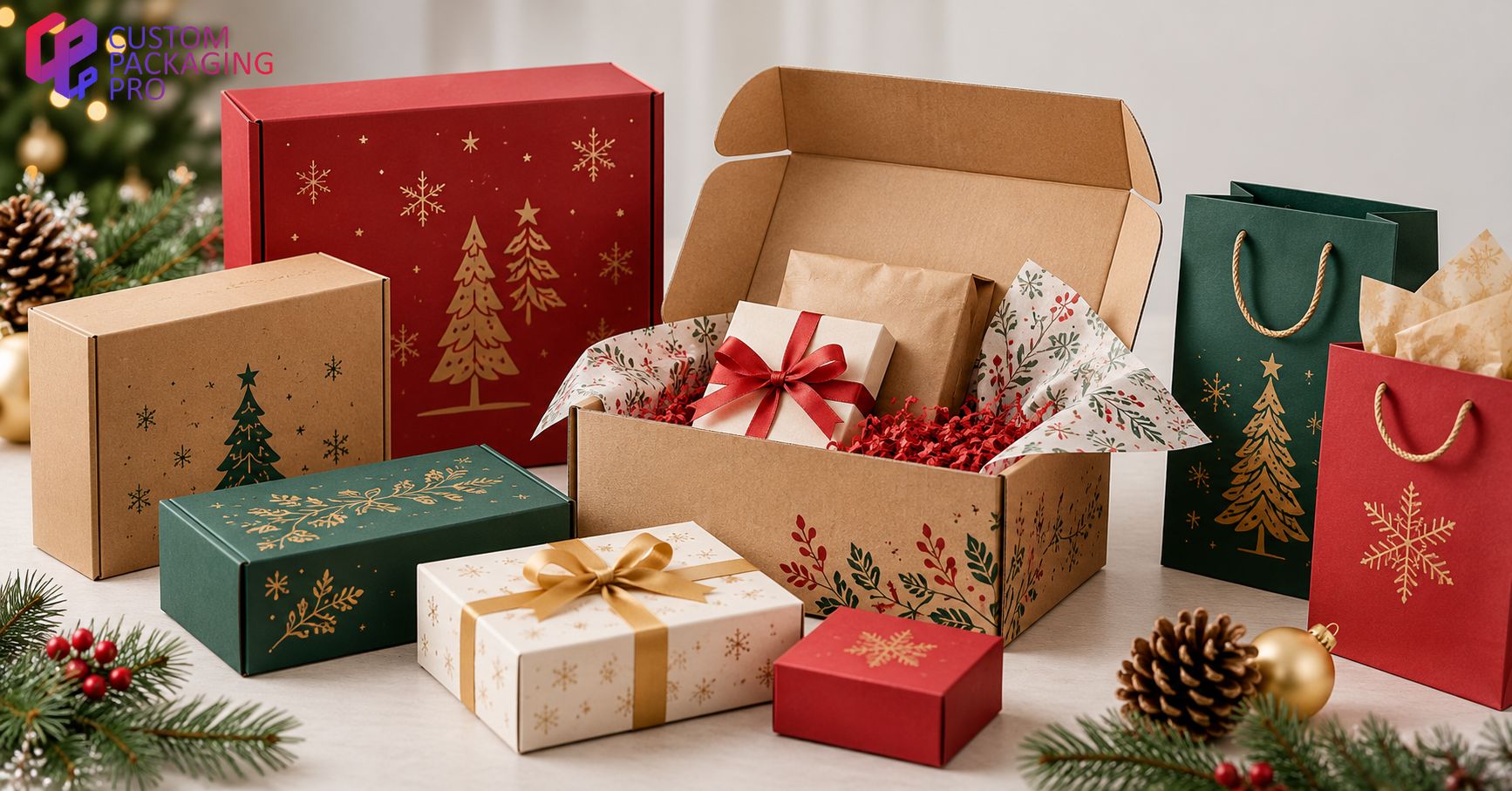
Holiday Packaging for UK Businesses: A Practical Christmas Packaging Guide
October 06, 2026
Christmas changes the way many products are bought. An item that spends most of the year as an everyday purchase may suddenly become a present, part of a festive bundle or a limited seasonal release. The packaging often needs to adapt with it.
For UK retailers, e-commerce sellers and product brands, holiday packaging offers a way to make that seasonal change visible. A business might introduce a dedicated Christmas box, update an existing pack with festive print, add a sleeve, or build several products into one gift set.
Appearance matters, but it should not be the starting point. The box still has to fit the product properly, provide the level of protection required and work with the way orders are packed, displayed or shipped.
This guide explains how businesses can plan Christmas and holiday packaging, from gift boxes and mailers to inserts, seasonal finishes, wholesale orders and packaging for different product categories.
Christmas & Holiday Packaging Guide for UK Businesses
What Does Holiday Packaging Mean for a Product Brand?
In a packaging context, holiday packaging means packaging developed or adapted for a particular celebration or seasonal campaign.
For UK businesses, Christmas is usually the biggest example. Seasonal packaging can range from a familiar product carton carrying temporary Christmas artwork to a completely bespoke presentation box created for a festive collection.
Common formats include:
- printed Christmas boxes
- rigid presentation boxes
- folding cartons
- mailer boxes
- shipping cartons
- packaging sleeves
- product inserts and dividers
- gift bags
- tissue and wrapping components
- ribbons and tags
- seasonal labels
Choosing between them starts with the product.
A necklace requires a very different pack from a candle set. An online gift bundle has different delivery requirements from an item sold from a retail shelf. A premium corporate gift may justify a rigid presentation box, while a smaller seasonal promotion might only require an updated sleeve around the brand's regular packaging.
Holiday Packaging Is Not the Same as a Package Holiday
These phrases look similar in search results but describe completely different things.
Holiday packaging belongs to the product packaging and gifting market. It covers festive boxes, seasonal retail packaging, Christmas gift presentation and related packaging.
Package holiday belongs to the travel market and normally refers to a trip sold as a combination of travel services.
Searches for package holiday deals, package holiday sale, packaged holidays or package holiday search therefore have travel intent. They are not relevant terms for a business trying to source Christmas boxes.
For packaging buyers, more useful terms include Christmas packaging, holiday gift packaging, Christmas gift boxes, festive packaging, seasonal boxes and custom Christmas packaging.
What Changes When Everyday Products Become Christmas Gifts?
During the festive period, customers may buy the same product for a different reason.
A candle becomes a stocking present. Several skincare products become a gift set. Jewellery becomes a ready-to-give purchase. A retailer may combine separate SKUs into one Christmas bundle.
The packaging needs to respond to that change.
At Christmas, the pack must protect the item while also supporting its branding, presentation and gift appeal. That does not automatically mean commissioning a completely new box.
A business could retain its established packaging and change only the artwork. Another could add a seasonal sleeve. Products being sold together for the first time might require a larger box and fitted insert.
The right level of seasonal customisation depends on what is being sold and how different the Christmas offer is from the standard range.
Holiday Packaging Ideas That Can Work for Christmas Campaigns
Give an Existing Box a Seasonal Edition
A recognisable brand does not need to disappear behind Christmas graphics.
Instead of replacing the entire visual identity, select a small number of festive elements and combine them with the packaging customers already recognise.
For example, the seasonal version could introduce:
- Christmas-specific illustration
- a temporary colour variation
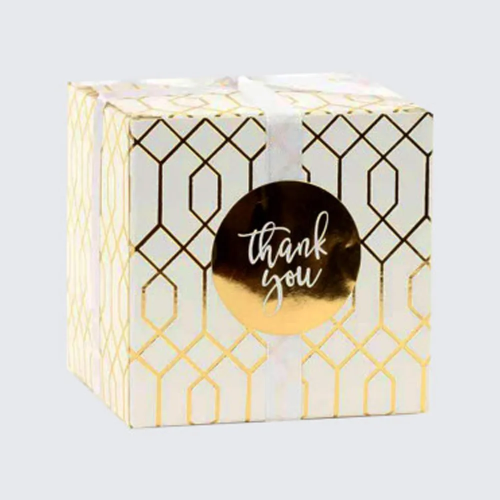
- metallic details
- festive patterns
- seasonal typography
- a message printed inside the box
This creates a limited-edition appearance without making the packaging feel unrelated to the rest of the brand.
Design the Gift Box Around What Goes Inside
A Christmas box should not be selected solely because it looks attractive.
Start with the contents.
Product dimensions, weight, fragility and the number of items inside will influence the box size and structure. If several products form one gift set, their arrangement should also be considered before artwork is finalised.
Custom gift packaging can be particularly useful for jewellery, cosmetics, candles, confectionery, accessories, promotional products and curated collections.
When the box is opened, the contents should still look intentional rather than simply occupying available space.
Get the product fit and box structure right before adding decorative details.
Use Rigid Boxes Where the Product Positioning Supports Them
A premium Christmas collection may call for packaging with more visual and structural presence.
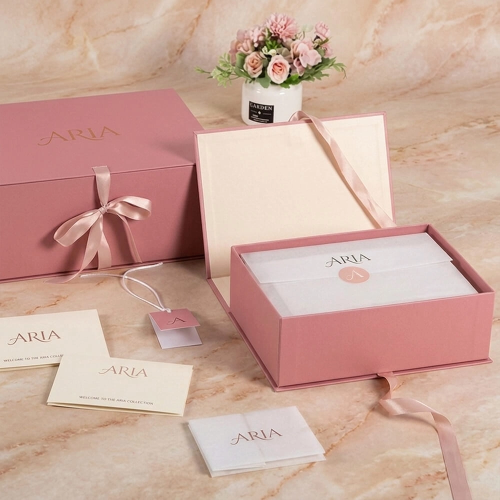
Rigid boxes can suit luxury gifts, corporate sets and higher-value products where the presentation is an important part of the purchase.
Depending on the project, a rigid format may incorporate:
- fitted inserts
- sleeves
- magnetic closures
- printed interiors
- foil details
- embossed elements
- debossed branding
The more expensive-looking option is not automatically the better option. Packaging should remain proportionate to the product, its retail position and the customer's expectations.
Turn Separate Products Into One Festive Set
Christmas gives businesses a natural opportunity to group complementary products.
A skincare company might combine several products into one routine. A candle brand could create a fragrance collection. A jewellery retailer might package coordinating pieces together.
| Product category |
Example seasonal set |
| Beauty |
Skincare or cosmetic collection |
| Jewellery |
Coordinated pieces |
| Candles |
Multi-fragrance gift set |
| Food |
Seasonal assortment |
| Fashion |
Accessory bundle |
| Wellness |
Self-care collection |
| E-commerce |
Curated multi-product gift |
When several items share one box, internal organisation becomes more important. Inserts and dividers can help establish individual positions for products instead of allowing everything to move together inside the pack.
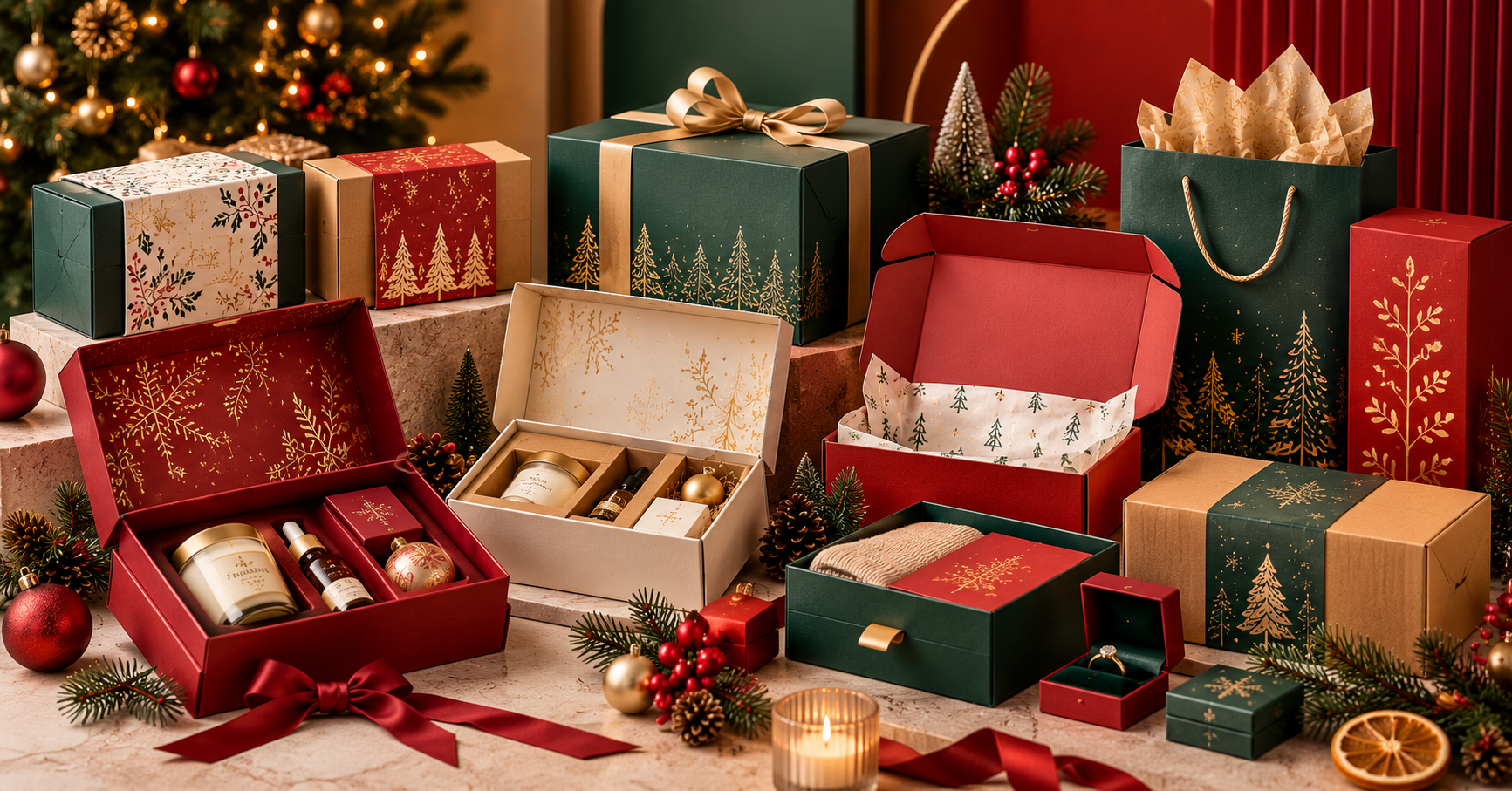
Add a Festive Sleeve to Standard Packaging
A business with existing packaging stock may not want to replace it for a short seasonal campaign.
A Christmas sleeve provides another route.
The main box can remain unchanged while the sleeve carries the temporary campaign design. After the festive period, the standard packaging can continue to be used without the seasonal component.
This can be useful when the underlying product remains unchanged and only its Christmas presentation needs to differ.
Plan Inserts as Part of the Presentation
The inside of a gift box deserves the same planning as its exterior.
Custom inserts can separate items, create a defined arrangement and help reduce unwanted movement. They are particularly relevant for bottles, jewellery, candles, electronics, cosmetics and multi-product sets.
Accurate product measurements matter here. An insert based on estimated dimensions may look correct in artwork but perform poorly once physical products are placed inside it.
For a polished result, internal structure and exterior design should be developed as parts of the same packaging concept.
Adapt E-commerce Packaging for Christmas Deliveries
Packaging for online orders faces a different journey from packaging placed directly on a shop shelf.
A Christmas order may pass through a packing station, sorting facilities, courier handling and final delivery before the recipient sees it.
That journey affects packaging choices.
A premium presentation box may need a separate shipping carton. In other cases, a well-designed custom mailer can provide both a branded opening experience and a format suitable for the product's delivery requirements.
For larger, heavier or more vulnerable orders, corrugated shipping packaging may be needed around the retail presentation.
The important test is how the package reaches the customer, not how it looks immediately after being packed.
Let Print Finishes Carry Some of the Festive Character
A Christmas design does not need to rely on obvious illustrations.
Finishing techniques can introduce seasonal character in a quieter way.
Foil stamping can add metallic details to a logo, border or selected artwork.
Embossing raises a chosen area of the surface.
Debossing creates a recessed impression.
Spot effects can draw attention to selected printed details.
Lamination can alter both the appearance and surface feel of a printed pack.
The material, print process, budget and desired result all influence which treatments are appropriate.
For some brands, one carefully chosen detail will communicate more than filling every panel with festive imagery.
Carry the Seasonal Theme Into the Opening Experience
A customer's first view of the product does not have to be the end of the Christmas design.
Interior print, an organised product arrangement, a seasonal note or complementary presentation elements can extend the concept inside the pack.
This is particularly relevant to e-commerce because opening the parcel may be the customer's first physical interaction with the brand.
The goal is consistency. The interior should feel connected to the exterior rather than like an unrelated second design.
Choosing a Christmas Colour Palette Without Losing Brand Recognition
Red and green may immediately signal Christmas, but using them is not a requirement.
Holiday packaging can also be built around:
- burgundy
- forest green
- navy
- cream
- black
- kraft tones
- silver
- soft neutrals
- muted pastels
- existing brand colours paired with seasonal accents
Start with the colours customers already associate with the business.
A skincare brand based around cream and muted tones might add a restrained metallic detail rather than switching to bright red. A luxury brand using black packaging might introduce a festive foil treatment while leaving its core palette intact.
The seasonal version should still be recognisable when placed beside the brand's normal products.
Matching Christmas Boxes to Different Product Categories
The word Christmas box describes an occasion, not one particular box construction. Product characteristics should determine the format.
Jewellery
Jewellery usually needs compact packaging with controlled internal presentation.
Boxes, pouches, inserts and rigid formats can all be relevant depending on whether the item is a ring, necklace, bracelet, watch or multi-piece set.
Businesses searching for personalised jewellery packaging or wholesale jewellery packaging in the UK should establish product dimensions and presentation requirements before deciding how much festive decoration to add.
Cosmetics and Beauty Products
Beauty brands frequently have an opportunity to combine complementary items during Christmas.
A seasonal set might contain jars, bottles, tubes or individual cartons in one larger package. An insert can give each component its own position and make the collection easier to present neatly.
The structure should be developed around the actual products, especially when containers vary in height, shape or weight.
Candles and Home Fragrance
Candles can work well as Christmas gifts, but the packaging has to account for the container as well as its presentation.
Glass jars and heavier vessels may require a different structure from lightweight accessories. Accurate sizing and suitable internal support become particularly important when candles are being shipped.
Seasonal print and finishes can then be applied to a box designed for the physical product.
Clothing and Fashion Accessories
Clothing is less rigid than many boxed products, which creates different packaging options.
Depending on the item and sales channel, businesses might use folding boxes, rigid gift boxes, mailers, sleeves or tissue as part of the presentation.
A premium accessory sold as a gift may justify a more substantial box, while an online clothing order may benefit from a format that uses delivery space efficiently.
Food and Confectionery
Christmas gifting can include chocolates, biscuits, baked goods, hampers and other food products.
Food packaging needs more than an attractive exterior. If a material will come into contact with food, its suitability for the intended use needs to be established.
A decorative outer gift box is not automatically suitable for direct food contact. The correct approach depends on the product, whether it already has primary packaging and the applicable food-packaging requirements.
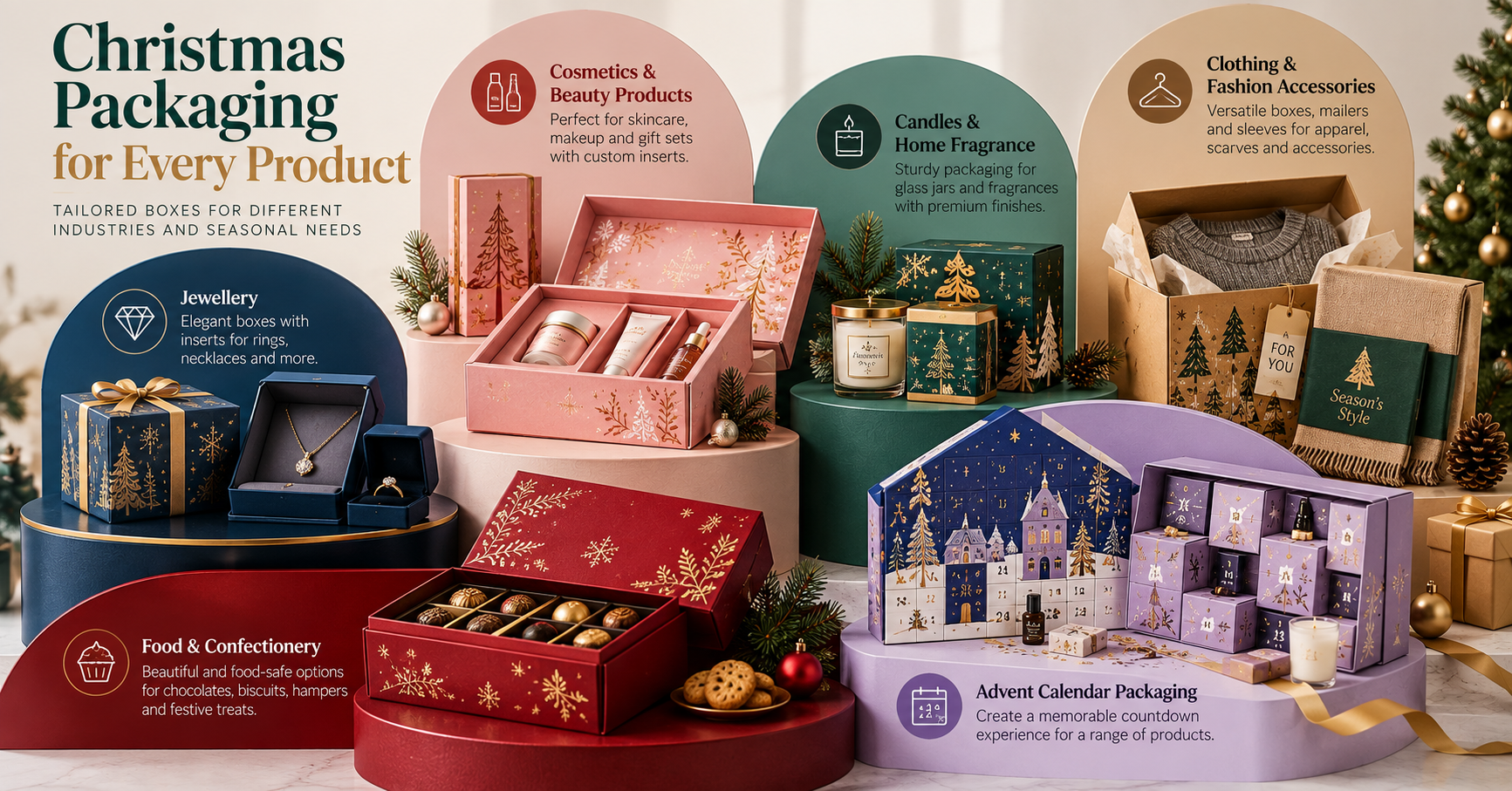
Where Advent Calendar Packaging Fits Into a Christmas Range
Advent packaging allows a brand to turn multiple small products or samples into a structured seasonal experience.
It is no longer limited to chocolate. Depending on product dimensions and suitability, the format can be considered for:
- cosmetics
- skincare
- jewellery
- accessories
- fragrance samples
- small candles
- packaged tea
- compact lifestyle products
The challenge is largely structural.
Every item needs an allocated space, and products may differ significantly in size. That means the internal layout should be established before the exterior artwork reaches its final stage.
A visually impressive Advent calendar that cannot comfortably accommodate its contents has been designed in the wrong order.
A Practical Approach to Holiday Packaging for Small Businesses
Small businesses can create a Christmas edition without changing every part of their packaging system.
Start by identifying the component customers notice most.
It may be enough to introduce one or two seasonal changes, such as:
- a printed sleeve
- limited-run artwork
- branded tissue
- Christmas labels
- an interior message
- a fitted insert
- festive product bundling
This keeps the project focused.
When comparing packaging boxes for a small business, also consider the operational side. A low unit price is less attractive if a box occupies excessive storage space, takes too long to assemble or increases postage unnecessarily.
The packaging has to work at the packing table as well as in the customer's hands.
Planning Wholesale Holiday Packaging
Christmas demand is concentrated into a limited trading period, so packaging quantities deserve early attention.
Businesses looking for holiday packaging wholesale should prepare a useful production brief rather than starting with appearance alone.
Before approaching a packaging supplier, gather:
- product dimensions
- required box dimensions, if already known
- estimated order quantity
- preferred packaging format
- material preferences
- print requirements
- artwork or branding information
- required finishes
- insert or divider requirements
- target date for receiving the packaging
This information helps turn a general idea into a packaging specification.
Seasonal timing also matters. Artwork approval, structural development, sampling where relevant, manufacturing, delivery and final product packing all need to happen before the campaign is due to launch.
Keep Christmas Packaging Connected to the Brand
Seasonal design works best when it adds to an established identity rather than covering it up.
Identify the elements customers already associate with the brand. These might include the logo, typeface, core colours, illustration style, tone of voice or familiar box format.
Keep the strongest of those elements and introduce Christmas around them.
For example, an existing box could retain its normal colour and typography but gain a temporary foil motif and festive interior message. Another brand could keep the same structure but create limited-edition seasonal artwork.
This creates continuity between the year-round range and the Christmas collection.
The objective is for customers to recognise the business before they notice the seasonal treatment.
Think About Material Use When Planning a Seasonal Pack
Christmas campaigns can introduce additional packaging components, especially when brands add sleeves, gift boxes, inserts, ribbons or shipping layers.
That makes it worth reviewing what each component actually contributes.
Questions to consider include:
- Is the box much larger than the product requires?
- Is an additional packaging layer necessary?
- Could an insert perform more than one function?
- Can seasonal artwork be applied to an existing structure?
- Are multiple materials being combined without a clear reason?
- Does reducing material compromise the protection the product needs?
UK businesses should also consider whether packaging legislation and Extended Producer Responsibility requirements apply to their organisation and packaging activities.
Sustainability decisions should be made alongside product protection, manufacturability and the realities of the supply chain rather than treated only as a marketing message.
What to Discuss With a Holiday Packaging Supplier
A productive supplier conversation should move quickly from “we need Christmas boxes” to a clear packaging brief.
Discuss the following areas.
Product fit: Provide accurate dimensions and relevant information about product weight or fragility.
Box construction: Decide whether the project calls for a folding carton, rigid box, mailer, corrugated shipper, sleeve or another format.
Internal presentation: Establish whether products need inserts, dividers or dedicated compartments.
Print: Explain which surfaces need artwork and whether interior printing is required.
Finishes: Identify foil, embossing, debossing or other effects that are important to the design.
Quantity: Share realistic order volumes so the packaging can be considered in the correct production context.
Schedule: Work backwards from the date the packaging needs to be available for packing, not simply from Christmas Day.
A clear brief reduces ambiguity and gives the supplier a better basis for discussing the project.
When Should Christmas Packaging Planning Begin?
There is no single lead time that applies to every custom packaging project.
A simple printed format and a complex rigid gift set do not involve the same amount of preparation. Sampling requirements, artwork readiness, finishing processes, quantities and production schedules can all affect timing.
Instead of relying on a generic deadline, build the project backwards from the date your team needs the finished packaging.
A typical planning sequence is:
- finalise the Christmas product or bundle
- measure every item
- choose the packaging format
- confirm the internal arrangement
- prepare artwork
- review proofs or samples where applicable
- approve production
- allow for delivery
- leave sufficient time for packing and fulfilment
Confirm the actual production schedule with the packaging supplier before committing the campaign to a launch date.
Custom Holiday Packaging for UK Brands
Custom Packaging Pro UK works with businesses that need bespoke packaging built around their products, branding and presentation requirements.
For a Christmas or seasonal project, that may involve gift boxes, rigid packaging, retail cartons, mailer boxes, corrugated formats, inserts or other custom packaging appropriate to the product.
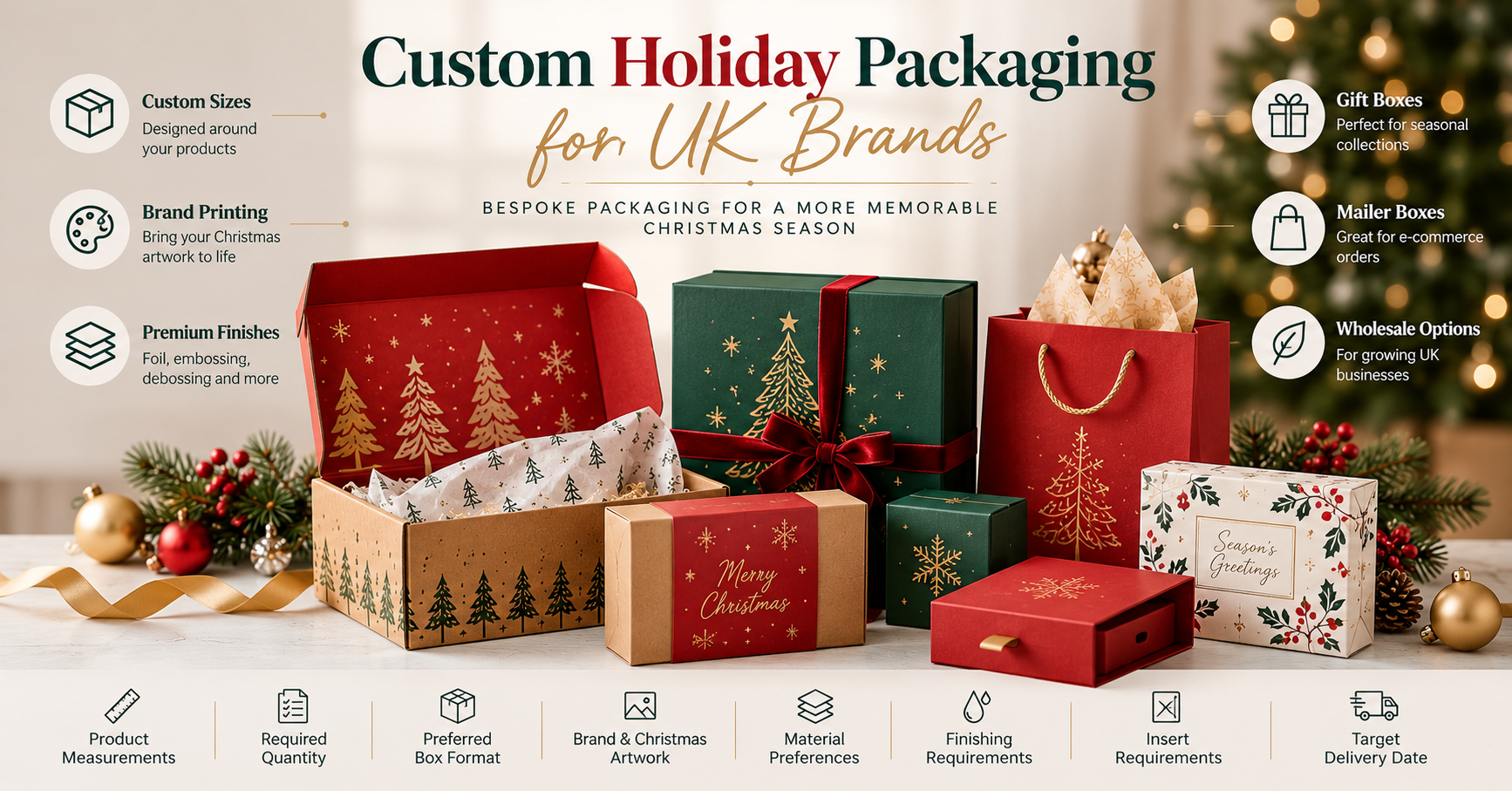
A useful project brief can include:
- product measurements
- required quantity
- preferred box format
- brand artwork
- Christmas campaign artwork
- material preferences
- print requirements
- finishing requirements
- insert requirements
- target delivery date
The aim should be more specific than making an ordinary box look festive. Good holiday packaging brings the seasonal concept together with product fit, brand recognition and practical use.
Businesses preparing a Christmas collection can send their specifications to Custom Packaging Pro UK for a custom packaging quotation.
Frequently Asked Questions
- What is holiday packaging?
Holiday packaging is packaging created or adapted for a seasonal occasion. In the UK, the term commonly applies to Christmas gift boxes, festive retail packaging, seasonal mailers, presentation boxes, sleeves, inserts and related packaging used for Christmas ranges and gifting.
- Is holiday packaging the same as a package holiday?
No. Holiday packaging refers to product packaging for seasonal occasions. A package holiday is a travel product. Searches relating to package holiday deals and packaged holidays therefore have a different intent.
- Can a business customise Christmas gift boxes?
Custom Christmas boxes can be developed around factors such as size, structure, artwork, material, internal presentation and finishing requirements. The available options depend on the chosen packaging specification.
- Does a small business need completely new packaging for Christmas?
Not necessarily. A small business may be able to adapt an existing format with seasonal artwork, a printed sleeve, labels, an interior message or another temporary component. The appropriate approach depends on the campaign and existing packaging.
- What type of box works for a Christmas gift set?
It depends on the products being combined. Their dimensions, weight, fragility, number and desired arrangement all influence the box format. Multi-item sets may also benefit from inserts or dividers.
- Are Christmas gift boxes suitable for shipping?
A presentation box and a shipping box perform different roles. Some packaging formats may be appropriate for e-commerce use, while premium gift boxes can require protective outer transit packaging. The decision should be based on the product and delivery conditions.
- Can businesses order Christmas packaging in wholesale quantities?
Custom packaging can be produced for commercial quantities, but the appropriate specification and pricing depend on factors such as dimensions, structure, material, printing, finishes and order volume.
- Which colours can be used for Christmas packaging?
Red, green, gold and silver are familiar festive choices, but brands can also work with navy, cream, burgundy, black, kraft tones, pastels or their established brand palette. Christmas design does not have to follow a traditional colour combination.
- Can holiday packaging be used for jewellery?
Yes. Jewellery can be presented in boxes, pouches, rigid formats or packaging with fitted inserts, depending on the product. Personalised jewellery packaging can also incorporate seasonal artwork while retaining the brand's established identity.
- How far in advance should a business plan Christmas packaging?
Planning should begin early enough to cover structural decisions, artwork, approvals, sampling where applicable, manufacturing, delivery and product packing. Because these variables differ by project, businesses should confirm the actual schedule with their supplier rather than rely on one universal lead time.